
You're staring at a full closet and still have nothing to wear to work. Sound familiar? A capsule office wardrobe solves that problem by stripping your professional wardrobe down to a curated set of pieces that mix and match effortlessly. No more decision fatigue at 7 a.m., no more impulse buys that gather dust on hangers.
The concept is simple: fewer, better pieces that all work together. When every item in your closet pulls its weight, getting dressed becomes the easiest part of your morning. And when those pieces are made from fabrics that resist wrinkles, wick moisture, and hold their shape, like the Tencel tops and tunics we make here at JudyP Apparel, your capsule works even harder for you.
This guide walks you through building a complete 15-piece office wardrobe from scratch. You'll learn which foundational items to choose, how to pair them for maximum outfit combinations, and where to invest versus where to save. Whether you're starting fresh or editing what you already own, this framework gives you a clear, repeatable system for getting dressed with confidence every workday.
What a capsule office wardrobe is and why it works
A capsule office wardrobe is a small, intentional collection of professional clothing where every piece works with every other piece. The term was popularized in the 1970s by London boutique owner Susie Faux, who argued that a handful of well-chosen items could outperform a bursting closet. The idea holds up today: when you limit what you own, you force yourself to choose things that are actually versatile, durable, and worth wearing repeatedly.
The definition: what counts as a capsule
Most work capsules land in the 10 to 15 piece range, not counting shoes and accessories. A piece earns its place by doing two things: it fits your workplace's dress code, and it combines with at least three other items in your collection to create distinct outfits. A top that only works with one specific pair of pants is a single-use item, and single-use items defeat the whole purpose.
Here is a quick test to check whether something belongs in your 15:
- Does it match your workplace dress code without modification?
- Can you pair it with at least three other pieces you own or plan to own?
- Does it hold its shape and appearance after repeated washing?
- Would you realistically reach for it at least once a week?
If a piece fails two or more of those checks, leave it out.
Why the math works in your favor
Fifteen pieces sounds restrictive until you run the actual numbers. With five tops, four bottoms, three layering pieces, and three dresses or complete outfits, the combinations a well-chosen set can produce run well above 30 distinct looks. That is enough variety to go six weeks without repeating an outfit in any obvious way.
The goal is not to own less for its own sake. It is to own pieces that all pull in the same direction, so the system works without effort.
The payoff is practical. You spend less time making decisions in the morning, less money on impulse purchases that never get worn, and less mental energy wondering whether an item "goes." Research from the American Psychological Association consistently shows that decision fatigue is real: the more low-stakes choices you make early in the day, the less cognitive energy you have for work that actually matters later.
The fabric question matters more than you think
Your capsule only works if the pieces stay in regular rotation, and that means the fabrics you choose matter as much as the silhouettes. A top that needs dry cleaning or careful ironing after every wear will quietly drop out of rotation no matter how much you like it. Pieces made from wrinkle-resistant, moisture-wicking, and easy-care materials are the ones that actually get worn week after week.
Tencel fabric is a strong example of this principle in action. It is soft, breathable, wrinkle-resistant, and machine washable, which makes it a practical choice for office tops and tunics that need to look polished after a full workday. When your pieces hold up to real wear and routine washing without extra maintenance, your capsule stays functional rather than aspirational. Fabric is not an afterthought; it is the reason some wardrobes stay organized for years while others collapse within a month.
Step 1. Set your dress code, needs, and palette
Before you pick a single piece for your wardrobe, you need a clear picture of what your wardrobe actually has to do. Skipping this step is the main reason people build capsules that look polished in theory and fail in practice. Take 10 minutes to honestly answer three questions: What does your workplace require? What does a typical work week look like for you in terms of activities and settings? And what colors do you genuinely reach for and feel confident wearing day after day?
Define your dress code tier
Your dress code sets the non-negotiable boundaries for every piece you choose. A business formal environment requires structured blazers, tailored trousers, and polished dresses. A business casual setting offers more flexibility, where well-fitted tops, tunics, and clean-cut pants work well together. Creative and casual offices give you the most latitude, but you still need to look intentional rather than haphazard.
Use this table to identify where your workplace lands and which key pieces it calls for:
| Dress Code | What It Looks Like | Key Pieces |
|---|---|---|
| Business Formal | Suits, structured dresses | Tailored blazer, sheath dress, pressed trousers |
| Business Casual | Smart tops, tailored pants | Tunic tops, chinos, wrap dress |
| Smart Casual | Clean, stylish basics | Quality tees, ponte pants, layering pieces |
Map your weekly schedule
Once you know your dress code, write out a typical work week day by day and add a one-line note about what each day involves. Do you meet clients on Tuesdays? Present to leadership on Fridays? Work remotely for two of the five days? Each of those scenarios shifts how many polished versus relaxed pieces your capsule needs to carry.
Write a one-line description for each workday before you shop for a single item. That exercise tells you exactly how many meeting-ready pieces you need versus everyday basics.
Choose your color palette
A capsule office wardrobe only works consistently if every piece can combine with every other piece, and color cohesion is what makes that possible. Pick two neutral anchors and one or two accent colors you genuinely enjoy wearing. Every item in your 15-piece edit should fall into one of those four slots.
A practical starting palette looks like this:
- Anchor 1: Black or navy (bottoms, blazers, dresses)
- Anchor 2: Gray or camel (trousers, layering pieces)
- Accent 1: White or ivory (tops, shells)
- Accent 2: One color you reach for naturally and feel comfortable in
When all your pieces share the same defined palette, you can combine them in any order and the outfit holds together without second-guessing yourself at 7 a.m.
Step 2. Choose your core 15 pieces
Now that you have your dress code, schedule, and palette locked in, you can make specific decisions about which 15 pieces earn a spot. The key is choosing items that multiply your outfit count rather than ones that just fill space. Think of each piece as a connection point: the more combinations it creates with other pieces in your collection, the more valuable it is to your system.
The complete 15-piece breakdown
Your capsule office wardrobe divides naturally into four categories: tops, bottoms, layers, and full outfits. Here is the breakdown that gives you maximum combinations without overlap or redundancy:
| Category | Pieces | Count |
|---|---|---|
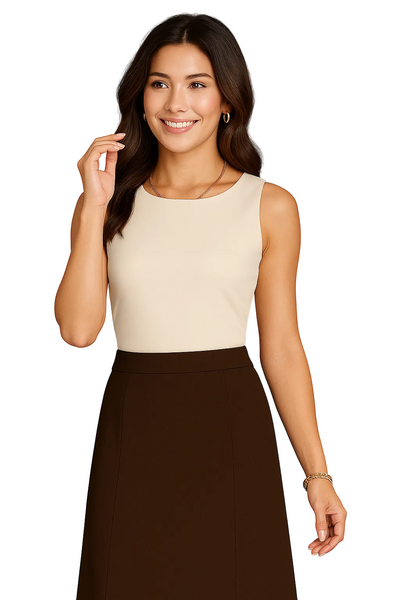
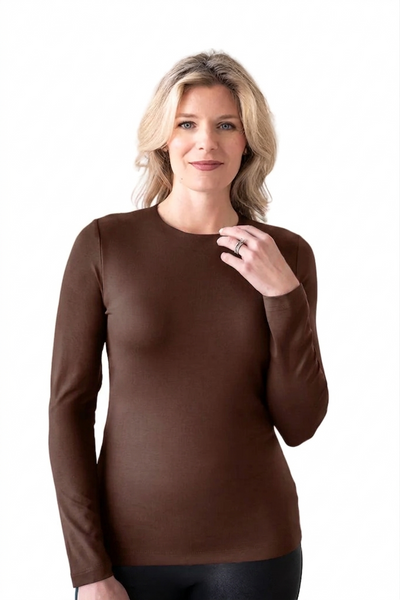
| Tops | 2 sleeveless shells, 2 short or ¾ sleeve tops, 1 long sleeve top | 5 |
| Bottoms | 2 trousers (one dark, one neutral), 1 pencil or A-line skirt, 1 clean-cut casual pant | 4 |
| Layers | 1 tailored blazer, 1 cardigan, 1 structured jacket | 3 |
| Full outfits | 2 dresses, 1 coordinated set | 3 |
Each category is deliberate and load-bearing. Five tops give you daily variety without redundancy. Four bottoms cover every meeting type your schedule demands. Three layering pieces shift a simple top into polished territory instantly. Three complete outfits give you grab-and-go options on the days you do not have the mental space to mix and match.
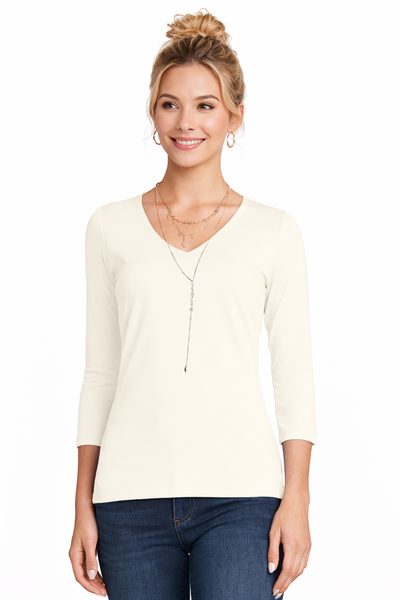
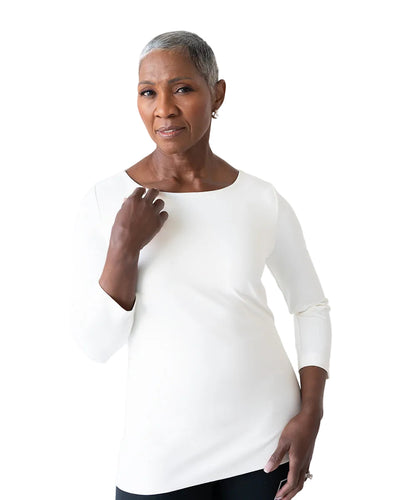
When selecting your foundational tops, starting with clean and sharp structures is highly effective. The geometric framing of the Sabrina Boatneck 3/4 Sleeve Top provides a beautiful collarbone-skimming silhouette that sits perfectly under tailored blazers. For a slightly sharper profile that anchors corporate suiting, the contours of the Deborah 3/4 Sleeve V-Neck Top give a crisp finish to your business-formal rotations.
Where to put your quality budget
Not every piece deserves the same investment level. Spend more on the items you wear most often and the ones that anchor the highest number of outfits. Blazers, trousers, and structured jackets carry the most weight in your capsule because they appear across the most combinations. A blazer that fits well and holds its shape will earn its cost back many times over compared to a trendy piece you wear twice.
Tops are where you can afford more variety, but only if the fabric genuinely holds up under repeated wear and washing.
For tops and tunics, fabric quality and easy care matter more than the price tag. A well-made top that is machine washable, wrinkle-resistant, and moisture-wicking will stay in your rotation far longer than a cheaper alternative that needs special handling after every wear. If your calendar includes long desk hours or frequent travel, opting for a fluid, breezy cut like the Karen Relaxed Fit 3/4 Sleeve V-Neck Top provides non-clinging movement all day. Alternatively, incorporating an extended length via the Sandra V-Neck 3/4 Sleeve Tunic ensures smooth, line-free coverage that layers seamlessly over slim-fit pencil skirts or trousers. Buy fewer pieces and make each one count by confirming you would realistically reach for it at least once a week before it earns its spot in your 15.
Step 3. Build 10 outfits from the 15 pieces
Having your pieces selected is one thing; knowing exactly how they combine is what turns a list into a working wardrobe. This step maps out 10 specific outfit formulas using the 15-piece framework so your capsule office wardrobe runs without effort from Monday through Friday.
A template for 10 proven combinations
The table below shows 10 outfits built directly from the categories in Step 2. Each combination uses pieces you already have, and each one is meeting-ready or easily made so with a single layering swap.
| Outfit | Top | Bottom or Full Outfit | Layer |
|---|---|---|---|
| 1 | Sleeveless shell | Dark trousers | Tailored blazer |
| 2 | Short sleeve top | Pencil skirt | Cardigan |
| 3 | ¾ sleeve top | Neutral trousers | None |
| 4 | Sleeveless shell | Clean-cut casual pant | Structured jacket |
| 5 | Long sleeve top | Dark trousers | None |
| 6 | Short sleeve top | A-line skirt | Tailored blazer |
| 7 | Dress 1 | None | Cardigan |
| 8 | Dress 2 | None | Structured jacket |
| 9 | Coordinated set | None | None |
| 10 | ¾ sleeve top | Pencil skirt | Tailored blazer |
Once you have these 10 combinations written down and tested, getting dressed becomes a two-second decision rather than a daily puzzle.
How to layer for different settings
Your layers do the heaviest lifting in this system. A sleeveless shell with dark trousers reads as a polished but relaxed look on a regular Tuesday. Add the tailored blazer, and the same two pieces carry you through a client meeting or a leadership presentation without changing anything else. Swapping the blazer for a cardigan shifts the same outfit from formal to approachable for collaborative workdays.
Practice these swaps before you actually need them. On a Sunday evening, pull out the pieces for your week and lay them flat for five minutes. You will immediately spot any issues, such as a top that pairs better with a different bottom than you originally planned, and fix it in five minutes rather than scrambling at 7:45 a.m. on a Wednesday. That small weekly routine keeps your system running smoothly rather than grinding to a halt when you are already short on time.
Step 4. Keep it polished with care and upgrades
Your capsule office wardrobe only stays functional if the pieces you chose actually hold up over time. A 15-piece system has no slack: when one item starts looking worn, faded, or misshapen, it affects every outfit combination that relies on it. Building a simple maintenance routine and knowing when to replace a piece are the two habits that keep your capsule working long after you build it.
Build a simple care routine
Your pieces need consistent, low-effort maintenance rather than occasional deep cleaning. Check care labels when you first buy each item and sort your garments into two groups: machine-washable everyday pieces and anything that needs special handling. If you find that more than two or three items in your 15 require dry cleaning or hand washing, swap them out for easier-care alternatives before they quietly drop out of rotation.
Follow this weekly care checklist to keep every piece in active use:
- Hang tops and dresses immediately after wearing to release any wrinkles before they set
- Machine wash wrinkle-resistant and easy-care fabrics like Tencel after every two wears
- Store blazers and structured jackets on wide-shouldered hangers to preserve their shape
- Check buttons, hems, and seams once a month and fix minor issues before they worsen
- Spot-clean small stains immediately rather than waiting for the next full wash cycle
The five minutes you spend on upkeep each week will prevent the need to replace a piece months earlier than necessary.
Know when to upgrade a piece
Replacing items at the right time is as important as buying them well in the first place. A piece signals that it needs to go when pilling appears on high-friction areas like underarms or cuffs, when the color has faded noticeably compared to when you first bought it, or when the fabric has lost its structure and no longer holds a clean silhouette. Do not wait until a piece looks visibly worn in front of a client or in a meeting.
Set a twice-yearly audit on your calendar, once in late spring and once in early fall, to pull every item from your 15-piece edit and assess it against those three markers. Replace one piece at a time rather than overhauling your wardrobe all at once, and always bring the replacement into your existing palette and combination system before retiring the old item.
Wrap it up and start wearing it
Building a capsule office wardrobe comes down to four clear steps: set your dress code and palette, choose your 15 pieces, map out your 10 outfit combinations, and maintain what you own. That framework gives you a repeatable system you can start using this week, not someday when you have more time or a bigger budget.
Start with what you already own. Pull everything from your closet, test each piece against the criteria in Step 1, and keep only what passes. Fill the gaps intentionally with easy-care, wrinkle-resistant pieces that hold up under real wear and weekly washing.
Your pieces matter as much as your system. For tops and tunics that are machine washable, wrinkle-resistant, and built to look polished all day, browse the full collection at JudyP Apparel and add pieces that will stay in your rotation for years.
Shop Capsule Office Foundations:
- Create geometric elegance beneath structured blazers with the Sabrina Boatneck 3/4 Sleeve Top.
- Anchor corporate or business-formal rotations with the tailored Deborah 3/4 Sleeve V-Neck Top.
- Enjoy breezy, wrinkle-free movement through busy desks and travel days in the Karen Relaxed Fit 3/4 Sleeve V-Neck Top.
- Secure an elongated drape and clean lines over trousers or skirts with the Sandra V-Neck 3/4 Sleeve Tunic.